
Our mission is to ensure the generation of accurate and precise findings.
Please enter subscribe form shortcode
Please enter instagram feed shortcode

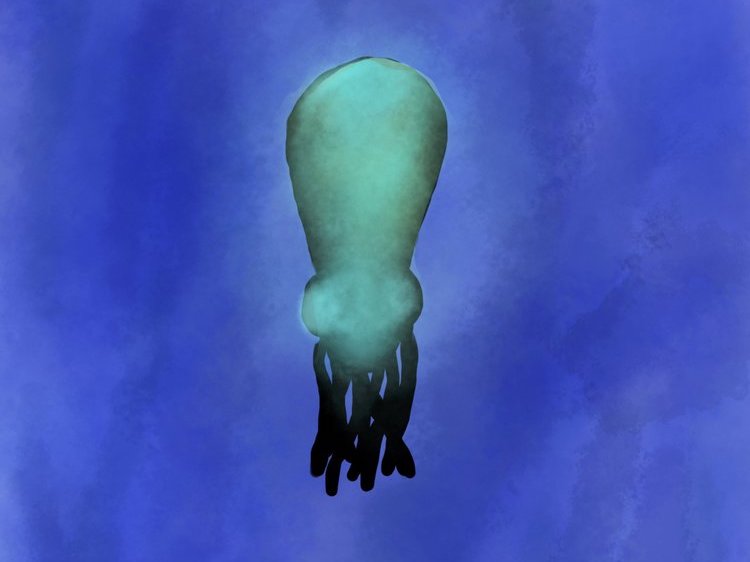
Imagine you’re a squid, yeah okay its weird but just imagine it, you are a squid swimming at night. It’s a dark night except for the light from the moon, and there is a predator roaming around looking for its dinner. Now imagine you are a squid who can camouflage yourself to match the light from the moon and the stars so your shadow disappears. You trick the predator while you go on your way looking for your own dinner. Seems kind of magical right? Well that’s exactly what bobtail squids do, except they get help from their bacterial friends. Today on RadioBio we talk with Dr. Michelle Nishiguichi, a professor at the University of California, Merced about glowing squids and their symbiotic sidekicks.
Go to Podcast >>
Art Credit: Julia Alvarez

Interference competition, wherein bacteria actively antagonize and damage their microbial neighbors, is a key ecological strategy governing microbial community structure and composition. To gain a competitive edge, bacteria can deploy a diverse array of antimicrobial weapons—ranging from diffusible toxins to contact-mediated systems in order to eliminate their bacterial rivals.
Read More
Biofilm formation is important for microbial survival, adaptation, and persistence within mutualistic and pathogenic systems in the Vibironaceae. Biofilms offer protection against environmental stressors, immune responses, and antimicrobial treatments by increasing host colonization and resilience. This review examines the mechanisms of biofilm formation in Vibrio species, focusing on quorum sensing, cyclic-di-GMP signaling, and hostspecific adaptations that influence biofilm structure and function.
Read More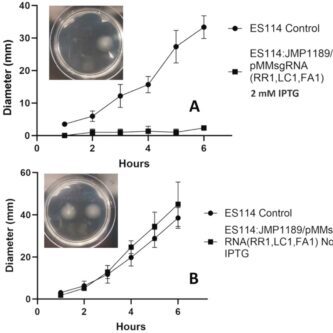
The Vibrio fischeri—Euprymna scolopes symbiosis has become a powerful animal—microbe model system to examine the genetic underpinnings of symbiont development and regulation. Although there has been a number of elegant bacterial genetic technologies developed to examine this symbiosis, there is still a need to develop more sophisticated methodologies to better understand complex regulatory pathways that lie within the association.
Read More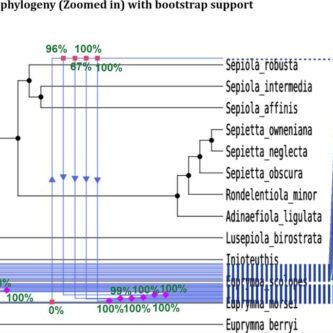
Cophylogenies represent coevolutionary histories of two or more sets of coevolved taxa, and are used to study coevolution and other fundamental evolutionary processes. As with traditional phylogenies, cophylogenies are primarily reconstructed using computational analysis of DNA and other biomolecular sequence data. An essential question concerns the reliability of reconstructed phylogenies and cophylogenies.
Read More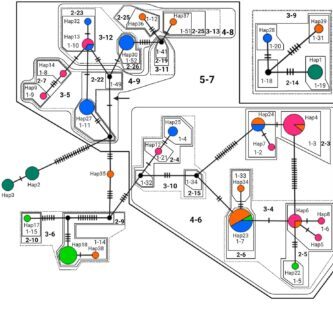
Symbiotic marine bacteria that are transmitted through the environment are susceptible to abiotic factors (salinity, temperature, physical barriers) that can influence their ability to colonize their specific hosts. Given that many symbioses are driven by host specificity, environmentally transmitted symbionts are more susceptible to extrinsic factors depending on conditions over space and time.
Read More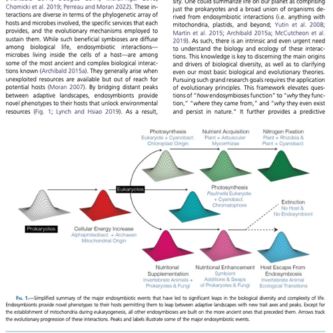
Life on Earth comprises prokaryotes and a broad assemblage of endosymbioses. The pages of Molecular Biology and Evolution and Genome Biology and Evolution have provided an essential window into how these endosymbiotic interactions have evolved and shaped biological diversity.
Read More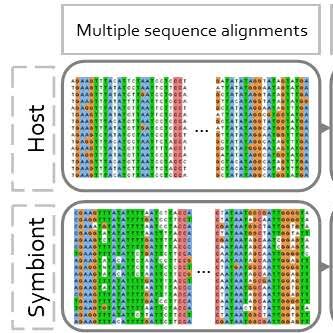
Just as a phylogeny encodes the evolutionary relationships among a group of organisms, a cophylogeny represents the coevolutionary relationships among symbiotic partners.
Read More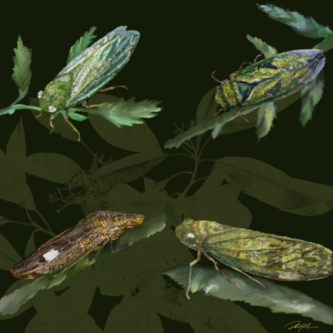
Chromosome-level genome assembly of the aster leafhopper (Macrosteles quadrilineatus) reveals the role of environment and microbial symbiosis in shaping pest insect genome evolution
Read More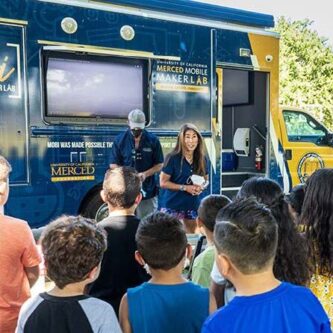
Through outreach to area schools and the opportunities afforded to undergraduates, INSITE and the affiliated faculty members are training the next generations of STEM scientists.
Read More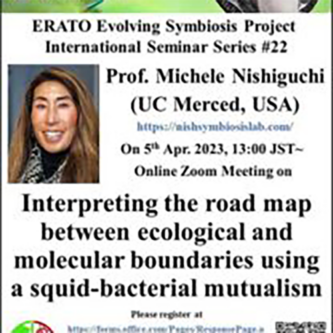
Prof. Michele Nishiguchi (University of California Merced, USA) “Interpreting the road map between ecological and molecular boundaries using a squid-bacterial mutualism”
Read More
Molecular and Cellular Biology Professor Michele “Nish” Nishiguchi has been inducted as a Fellow of the California Academy of Sciences and was recently named president-elect for the Society for Integrative and Comparative Biology (SICB).“Interpreting the road map between ecological and molecular boundaries using a squid-bacterial mutualism”
Read More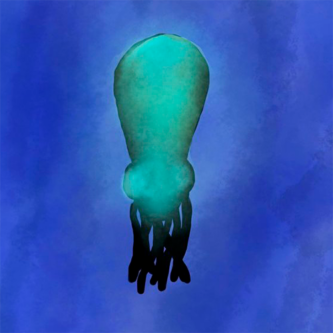
Prof. Michele Nishiguchi (University of California Merced, USA) “Interpreting the road map between ecological and molecular boundaries using a squid-bacterial mutualism”
Read More
UC Merced has received a $12.5 million grant funded by the National Science Foundation (NSF) to develop the Biology Integration Institute (BII): INSITE — the INstitute for Symbiotic Interactions, Training and Education — a research collaborative that aims to expand the fundamental knowledge of symbioses and inform immediate and long-term conservation strategies in the face of climate change.
Read More
From understanding the multifaceted transmission of disease to deciphering how living organisms adapt to harsh conditions, answering big questions in biology requires interdisciplinary research and scientists engaging and partnering with those from other fields of study.
Read More